How Western
Civilization Fell Prey to Mild Acidosis  Cancers thrive in an acidic environment -- not an alkaline one.
What's more, cancer isn't the only degenerative disease to share this
characteristic."Modern civilization has made more changes to the pH of
the diet of homo sapiens in the last forty years than it has in the
previous forty thousand. . . And it's all acidic. . ." It's a simple fact, seemingly
tangential to any of the most
recognized therapies used in the cancer field today. But it isn't. The
adjustment of pH from acidic (5.8 and lower) to a more neutral (though
slightly acidic) pH of around 6.4, is considered critical by many
clinicians. (Note: These values reference the average pH of bodily fluids,
like urine and saliva, separate and apart from blood, for which the
body employs homeostatis to keep the blood at between pH 7.35 and 7.45).
This is the average many alternative cancer care practitioners talk about
when discussing the gradual shift to more acidic foods, including an
epidemiological state of mild acidosis that has caused an increase in not
just cancer, but also MS and diabetes. The "acid shift" is well-known and documented, as Westerners have
moved more towards processed foods, and away from a diet of fresh foods.
The fact is, modern civilization has made more changes to the pH of the
diet of homo sapiens in the last forty years than it did in the previous
forty thousand -- and, in the name of "shelf stability," it is all acidic.
"The explosion in the use of food-grade acidulents was
completely predictable: there is not a single preservative that doesn't
work more effectively in an acidic substrate."Processed foods, especially those
that contain water in the 15-50% range (called "intermediate moisture"
foods by food technologists), all require preservatives. The explosion in
the use of food-grade acidulents, including citric, phosphoric, malic,
tartaric, and lactic acids, was completely predictable: there is not a
single preservative that doesn't work more effectively in an acidic
substrate. In fact, there is not one single food-grade preservative
approved by a Western food and drug agency that will work better in a
neutral or alkaline environment than it will in an acidic one. The most
popular antimicrobial preservatives in use, including all sorbates,
benzoates, proprionates, parabens, nitrates, and their salts -- all of
them -- all require pH ranges that are well below 4.0 to work optimally.
This isn't speculation: it's hornbook food science. Acidulents are
everywhere: every can of soda pop, every IM snack product, every jar of
tomato sauce, every loaf of bread. Two hundred years ago most of these
acidulents weren't even chemically identified, let alone put into use.
Today they are ubiquitous. They have thoroughly infiltrated the food
supply. None of this is to
suggest that most of these preservatives (most of them are fatty acids, so
they're acidic, too) or the acidulents used to make them work better and
acidify foods, are inherently harmful. Except for nitrates, there is no
credible research to show that approved preservatives are harmful. It is
not the preservatives themselves that are harmful. It is the acidic
metabolic environments that acidulents and preservatives create in the
absence of more alkaline food stuffs that do the damage. Clinicians who understand the
importance of pH balance will often have their patients measure the pH of
urine and saliva over several days to see if it is imbalanced. The best
time to do this is upon arising in the morning -- well before breakfast.
Cancer patients are almost never found to have a pH that is not
considerably more acidic than the mean. (One doctor has told us that his
cancer patients measure an average of about 5.6, and normal, healthy
patients measure about 6.4. This is significant when we take into account
that the pH scale is logrithmic: 5.0 is 10 times more acidic than 6.0).
In the main article (at right)
we discuss how pH ties together several different therapies and could help
us explain other disease states that appear to be unique in their
frequency starting in the early-to-mid 1900's and continuing to the
present. We have much research
yet to do, but a clear picture is beginning to emerge: you cannot strongly
acidify the diet of an entire civilization without seeing a dramatic
upsurge in acid-related disorders.And a correlation between both now appears evident -- and,
indeed, historic. Cancers thrive in an acidic environment -- not an alkaline one.
What's more, cancer isn't the only degenerative disease to share this
characteristic."Modern civilization has made more changes to the pH of
the diet of homo sapiens in the last forty years than it has in the
previous forty thousand. . . And it's all acidic. . ." It's a simple fact, seemingly
tangential to any of the most
recognized therapies used in the cancer field today. But it isn't. The
adjustment of pH from acidic (5.8 and lower) to a more neutral (though
slightly acidic) pH of around 6.4, is considered critical by many
clinicians. (Note: These values reference the average pH of bodily fluids,
like urine and saliva, separate and apart from blood, for which the
body employs homeostatis to keep the blood at between pH 7.35 and 7.45).
This is the average many alternative cancer care practitioners talk about
when discussing the gradual shift to more acidic foods, including an
epidemiological state of mild acidosis that has caused an increase in not
just cancer, but also MS and diabetes. The "acid shift" is well-known and documented, as Westerners have
moved more towards processed foods, and away from a diet of fresh foods.
The fact is, modern civilization has made more changes to the pH of the
diet of homo sapiens in the last forty years than it did in the previous
forty thousand -- and, in the name of "shelf stability," it is all acidic.
"The explosion in the use of food-grade acidulents was
completely predictable: there is not a single preservative that doesn't
work more effectively in an acidic substrate."Processed foods, especially those
that contain water in the 15-50% range (called "intermediate moisture"
foods by food technologists), all require preservatives. The explosion in
the use of food-grade acidulents, including citric, phosphoric, malic,
tartaric, and lactic acids, was completely predictable: there is not a
single preservative that doesn't work more effectively in an acidic
substrate. In fact, there is not one single food-grade preservative
approved by a Western food and drug agency that will work better in a
neutral or alkaline environment than it will in an acidic one. The most
popular antimicrobial preservatives in use, including all sorbates,
benzoates, proprionates, parabens, nitrates, and their salts -- all of
them -- all require pH ranges that are well below 4.0 to work optimally.
This isn't speculation: it's hornbook food science. Acidulents are
everywhere: every can of soda pop, every IM snack product, every jar of
tomato sauce, every loaf of bread. Two hundred years ago most of these
acidulents weren't even chemically identified, let alone put into use.
Today they are ubiquitous. They have thoroughly infiltrated the food
supply. None of this is to
suggest that most of these preservatives (most of them are fatty acids, so
they're acidic, too) or the acidulents used to make them work better and
acidify foods, are inherently harmful. Except for nitrates, there is no
credible research to show that approved preservatives are harmful. It is
not the preservatives themselves that are harmful. It is the acidic
metabolic environments that acidulents and preservatives create in the
absence of more alkaline food stuffs that do the damage. Clinicians who understand the
importance of pH balance will often have their patients measure the pH of
urine and saliva over several days to see if it is imbalanced. The best
time to do this is upon arising in the morning -- well before breakfast.
Cancer patients are almost never found to have a pH that is not
considerably more acidic than the mean. (One doctor has told us that his
cancer patients measure an average of about 5.6, and normal, healthy
patients measure about 6.4. This is significant when we take into account
that the pH scale is logrithmic: 5.0 is 10 times more acidic than 6.0).
In the main article (at right)
we discuss how pH ties together several different therapies and could help
us explain other disease states that appear to be unique in their
frequency starting in the early-to-mid 1900's and continuing to the
present. We have much research
yet to do, but a clear picture is beginning to emerge: you cannot strongly
acidify the diet of an entire civilization without seeing a dramatic
upsurge in acid-related disorders.And a correlation between both now appears evident -- and,
indeed, historic. |
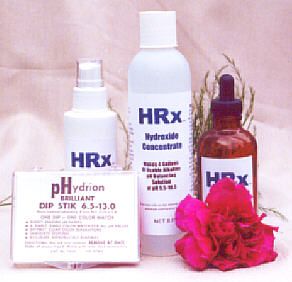 The set above was first introduced in 2001, well before the FDA raid that destroyed our U.S. lab in 2003. 
Hydroxide
Concentrate: An Introduction
Code: 1085 -- $14.95
(free shipping not included) Code: FS1085 -- $26.95 (incl. free shipping internationally) General Use HRx Instructions  Testimonials
 he companion to our H3O Concentrate, the HRx Hydroxide
Concentrate draws from the same proprietary technology, only it
carries entirely different applications. Whereas H3O is
a super pure, non-corrosive acid, HRx is its alkaline counterpart.
The HRx concentrate measures about pH 13.5 -- so it should be violently
caustic, and yet it is not. Coming from the same technology as H3O, this
is not surprising... Since so
much of Alpha Omega Lab's work has centered around cancer,
(accelerated by our work in third world countries where people cannot
afford conventional treatment to begin with), this became our starting
point.Early in our work with
HRx, it became apparent that it had dramatic potential in overall
nutrition, particularly for those suffering from most types of cancer;
adult diabetes; and possibly muscular dystrophy. Our suspicions were
entirely theoretical. We were
aware, for instance, that many of those who view cancer as a "nutrient
deficiency" disorder -- even those who concur with the polymorphic
microorganism theories of Antoine Bechamp, Royal Rife, and others; or such
etiological theories as "parasitic carcinogenesis" (i.e. Hulda Clarke) --
acknowledge the harmful role of pH imbalance. Genius is not required to
acknowledge the obvious: cancers cannot grow or even survive in an
alkaline, or even a neutral, pH environment. They require acidity.
In working with the inventors
of HRx, we came to understand that if you made ordinary drinking water
with it regularly, bringing the "water" to a pH of approximately 9.0, and
you drink it, the pH of saliva and urine samples will reflect values in
the 6.4 to 7.0 range -- not 5.2 to 5.9. This meant that HRx indisputably
brought the entire circulatory system, and therefore the organ tissues
through which the blood passes, into less acidic pH ranges. But the next
question was not so easy to answer: is there really much significance in
making the body less acidic? And does this observation, now confirmed
after fifteen years of use, bring any relief to a patient who has a disease
that is created because of mild acidosis to begin with? In other
words, so what if acidosis brought on the cancer -- will reversing the
acidosis benefit the patient now that the cancer process is already in
place? And what about the many other maladies that, in whole or in part,
are aggrevated, if not created, as a result of a pH imbalanced physiology
biased to acidity? Even at
this writing, we do not have enough empirical evidence, let alone
well-constructed longitudinal studies, to support conclusive findings,
despite some of the miraculous anecdotal comments we have received. What
we can rely on is the clinical findings of doctors we have consulted in
several countries -- physicians we know and respect. And this is what we
know:The effectiveness
(putting aside any toxicological issues for a moment) of the leading
alternative cancer treatments in use today, in part, draw their efficacy
from the fact that they mildly adjust the pH upward. These include: (1)
hydrogen peroxide (H2O2) therapy, (2) ozone therapy, (3)
cesium, and (4) coral water or coral powder. Improperly
handled, all three can be quite toxic when used internally. We know
through experimentation that none of these will bring as quick a change in
pH balancing as will HRx. (Enthusiasts of bio-oxidative therapies
will be quick to point out, however, that in the case of hydrogen peroxide
and ozone, it is the oxygenation and not the pH balancing, that are behind
the benefits, since cancers cannot survive in aerobic environments,
either.) With this working
knowledge in hand, we now feel confident to recommend the following
as a nutritional support adjunct to our internal Cansema
products (capsules and Tonic
III, as well as a general purpose pH balancing program: he companion to our H3O Concentrate, the HRx Hydroxide
Concentrate draws from the same proprietary technology, only it
carries entirely different applications. Whereas H3O is
a super pure, non-corrosive acid, HRx is its alkaline counterpart.
The HRx concentrate measures about pH 13.5 -- so it should be violently
caustic, and yet it is not. Coming from the same technology as H3O, this
is not surprising... Since so
much of Alpha Omega Lab's work has centered around cancer,
(accelerated by our work in third world countries where people cannot
afford conventional treatment to begin with), this became our starting
point.Early in our work with
HRx, it became apparent that it had dramatic potential in overall
nutrition, particularly for those suffering from most types of cancer;
adult diabetes; and possibly muscular dystrophy. Our suspicions were
entirely theoretical. We were
aware, for instance, that many of those who view cancer as a "nutrient
deficiency" disorder -- even those who concur with the polymorphic
microorganism theories of Antoine Bechamp, Royal Rife, and others; or such
etiological theories as "parasitic carcinogenesis" (i.e. Hulda Clarke) --
acknowledge the harmful role of pH imbalance. Genius is not required to
acknowledge the obvious: cancers cannot grow or even survive in an
alkaline, or even a neutral, pH environment. They require acidity.
In working with the inventors
of HRx, we came to understand that if you made ordinary drinking water
with it regularly, bringing the "water" to a pH of approximately 9.0, and
you drink it, the pH of saliva and urine samples will reflect values in
the 6.4 to 7.0 range -- not 5.2 to 5.9. This meant that HRx indisputably
brought the entire circulatory system, and therefore the organ tissues
through which the blood passes, into less acidic pH ranges. But the next
question was not so easy to answer: is there really much significance in
making the body less acidic? And does this observation, now confirmed
after fifteen years of use, bring any relief to a patient who has a disease
that is created because of mild acidosis to begin with? In other
words, so what if acidosis brought on the cancer -- will reversing the
acidosis benefit the patient now that the cancer process is already in
place? And what about the many other maladies that, in whole or in part,
are aggrevated, if not created, as a result of a pH imbalanced physiology
biased to acidity? Even at
this writing, we do not have enough empirical evidence, let alone
well-constructed longitudinal studies, to support conclusive findings,
despite some of the miraculous anecdotal comments we have received. What
we can rely on is the clinical findings of doctors we have consulted in
several countries -- physicians we know and respect. And this is what we
know:The effectiveness
(putting aside any toxicological issues for a moment) of the leading
alternative cancer treatments in use today, in part, draw their efficacy
from the fact that they mildly adjust the pH upward. These include: (1)
hydrogen peroxide (H2O2) therapy, (2) ozone therapy, (3)
cesium, and (4) coral water or coral powder. Improperly
handled, all three can be quite toxic when used internally. We know
through experimentation that none of these will bring as quick a change in
pH balancing as will HRx. (Enthusiasts of bio-oxidative therapies
will be quick to point out, however, that in the case of hydrogen peroxide
and ozone, it is the oxygenation and not the pH balancing, that are behind
the benefits, since cancers cannot survive in aerobic environments,
either.) With this working
knowledge in hand, we now feel confident to recommend the following
as a nutritional support adjunct to our internal Cansema
products (capsules and Tonic
III, as well as a general purpose pH balancing program:General Use Instructions *
|
New for 2016
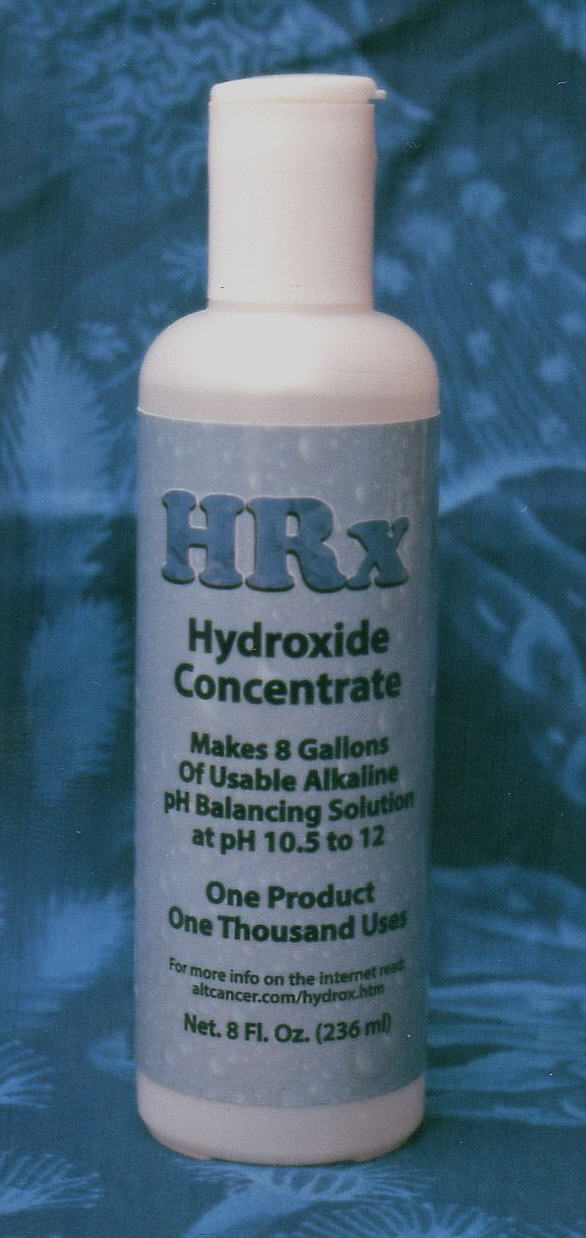 Beginning January 4, 2016, we will be offering our
new and improved version of HRx for $26.95 ---
FREE SHIPPING WORLDWIDE!
Beginning January 4, 2016, we will be offering our
new and improved version of HRx for $26.95 ---
FREE SHIPPING WORLDWIDE! "Early Hour" Hydration Therapy There are numerous web sites that discuss
the tremendous health benefits of "hydration therapy." What HRx does is
add an entirely new range of benefits to this basic technique, but we'll get to
that in a moment. For now, the benefits of "hydration therapy" -- a fancy term
for drinking purified water at specific times of the day -- should be reviewed
for those who don't know them. At the least, the following benefits can
be experienced simply by taking a large glass of water in the morning,
upon arising:
(1) Weight Loss -- Drinking chillded water in the morning upon
arising raises the metabolism, reportedly as much as 25%. (The body
expends calories to bring the water to body temperature). Additionally,
water fills the stomach, acting as a mild appetite suppressant.
(2) Removes Toxins --Water is the medium the body uses to flush
out toxins. With additional hydration using the techniques in this section,
you will eliminate more of the substances that lead to disease states.
(3) Improved Cardiovascular & Lymph Flow --The circulatory pathways
of the body are all improved with the regular consumption of purified
water with no additional additives. You wouldn't attempt to clean
the outside of your body with sodas, coffee, teas, or even juices.
So don't expect your "internal environment" to be "clean" if you
don't use water . . . the same medium you use to bathe.
(4) Healthier Skin -- Extra hydration helps the cardiovascular
system clean the dermal layers. The result is skin that is improved
in appearance and texture.
(5) Improved Regularity --You don't have to be constipated to
have less than optimal bowel regularity. You can get a sense of this
when you perform this "therapy" with consistency. The first bowel
movement of the morning is soft, complete, and there is no effort
to expel.
(6) Emelioration of Other Conditions --There is almost no serious
and/or chronic condition that will not improve with proper hydration,
ranging from cancer, diabetes, hepatic and renal diseases, etc.The timing of "early hour
hydration therapy" is important. Some commentators recommend
upon
arising or
after you
'get up'.In our research, however, after 25 years
of investigating this area and running a colon hydrotherapy clinic in Lousiana
in the 90's -- (another form of systemic hydration) -- we have come to the conclusion
that the best TIME to drink extra water is during the night, after using the bathroom,
and/or before getting out of bed. The reason is the pyloric valve (which is the
gateway between the stomach and the deodenum) is still periodically open, allowing
for a more thorough "water flush."And this takes us to our final point:
a very effective method of getting more complete hydration AND alkalizing the
body overall is to prepare "HRx water" at the 1:128 ratio, as per the
instructions in the center column, and let THIS be your drinking water.The benefits begin to be experienced
within a day or two, and unlike the Kelmun Protocol
and other techniques that incorporate sodium bicarbonate, there are no sodium
electrolyte imbalances that result from use. (HRx contains only two mineral
ions of note: calcium and potassium).Use with Colon
Hydrotherapy  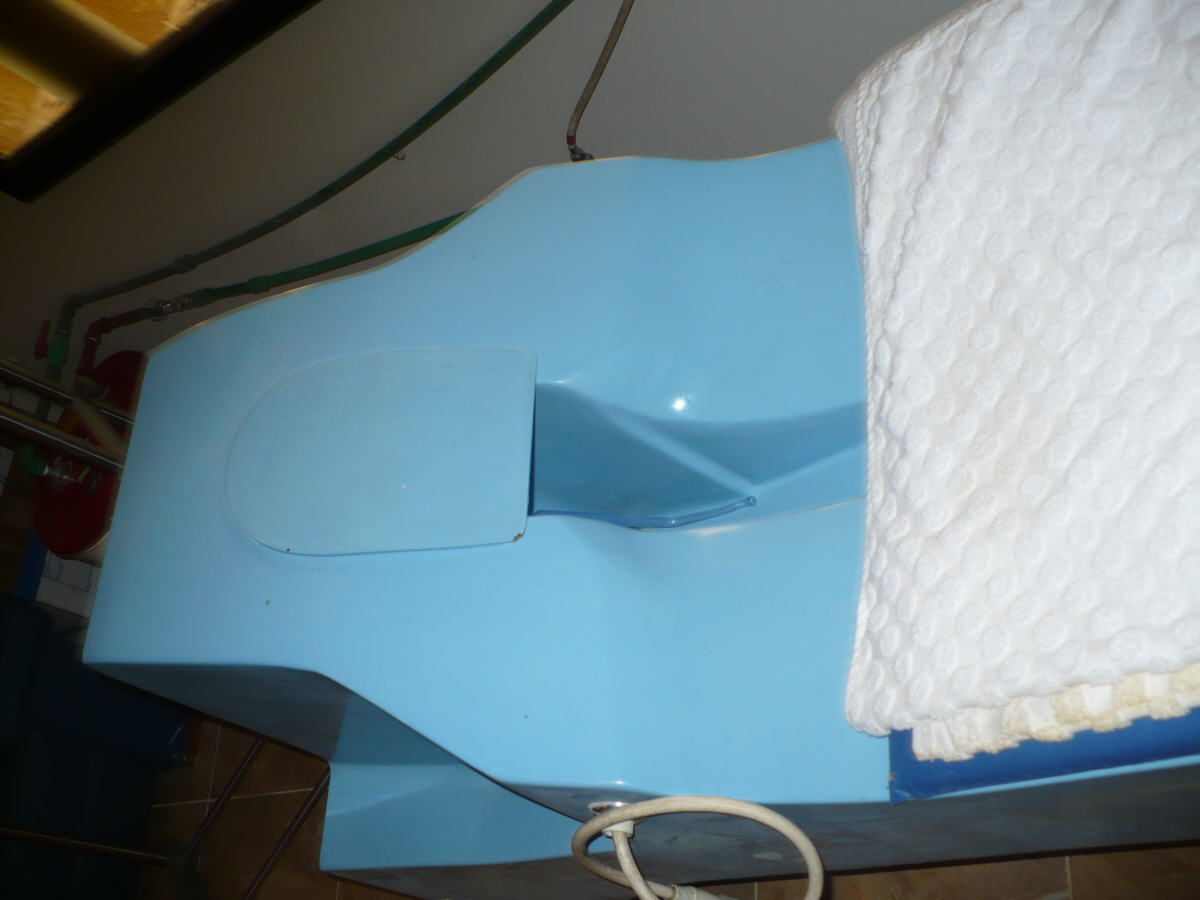 Cathryn and I used to run a colon
hydrotherapy clinic in the early 90's, while running Alpha Omega Labs --
(this was before we posted Alpha's first website, Altcancer.com, in 1995).
Among the techniques we used in our work was introducing alkaline and
oxygenated water into the system. This will be the subject of an
upcoming article . . .
Cathryn and I used to run a colon
hydrotherapy clinic in the early 90's, while running Alpha Omega Labs --
(this was before we posted Alpha's first website, Altcancer.com, in 1995).
Among the techniques we used in our work was introducing alkaline and
oxygenated water into the system. This will be the subject of an
upcoming article . . . | |
|
Case #021402: HRx &
Diabetes Just a quick word to let you know how well HRx
has worked for me in controlling my blood sugar. I use Glucaphage to help
control (it), but I still have numbers that are in the 180 to 200 range.
Within two days of taking HRx, I saw my blood sugar settle into 120 to
130, and it has stayed there consistently since I began taking it three
months ago. I can't say whether or not it would work for other diabetic
patients this well, but considering its low cost, ease of use, and no
toxicity, they have nothing to lose.... Thanks! (Tracy Ballman - USA -
2/14/2002)Case #030602: HRx & Chronic
Heartburn Good Day! I am a 50 year old male who has
suffered most of my adult life from chronic heartburn. I located your
website searching for help to treat an absess/tumor on one of my older
dogs. I read a lot of what you had to say and ended by purchasing your
black salve, H30 and HRx. I used the black salve and H3O to treat my dog.
The results were nothing short of remarkable. I know your products have
extended her life. The tumor
has completely disappeared and I did not have to subject her to a major
surgury at age 13. Back to the heartburn. I was intrigued by your
discussions of acidity levels in a person's body. I decided to use the
sample bottle of HRx for myself. Thirty-five days ago I began drinking water with a small amount
of HRx mixed in. Within a day or two I stopped having heartburn attacks
and I haven't had one since. Adjusting the acidity of my body to a
slightly alkali condition has made all the difference. I also have a fatty
tumor on my side, outside my ribcage. It has been there for over 15 years
and has gradually gotten larger. After just 35 days your product has reversed that trend and it
has, clearly, reduced in size. In closing, I have just made another order
of your products. I am sending some to my older brother who also has
chronic heartburn. I will let you know if he has similar results. Please
keep up the good work. (Rick Bell - rbell@peoplepc.com -
3/6/02) | |||